AI Visibility Sprint · a No7 Software engineering engagement
Your customers now ask ChatGPT first. The answer doesn’t mention you.
In 14 days we make your business citable, and cited, in AI answers. Visibility is measured on a written panel of buyer questions we define for your market and hand you at kickoff. If you’re not being cited by day 14, you get every penny back.
Booking takes two minutes: run the check, leave your details, pick a 15-minute call slot.
Don’t take our word for it. Ask the engines.
Type “shopify plus pricing uk 2026” into ChatGPT or Perplexity right now. Both cite our analysis by name. That page competes against Shopify itself for that answer, and it earned the slot with the same work the sprint does for you.
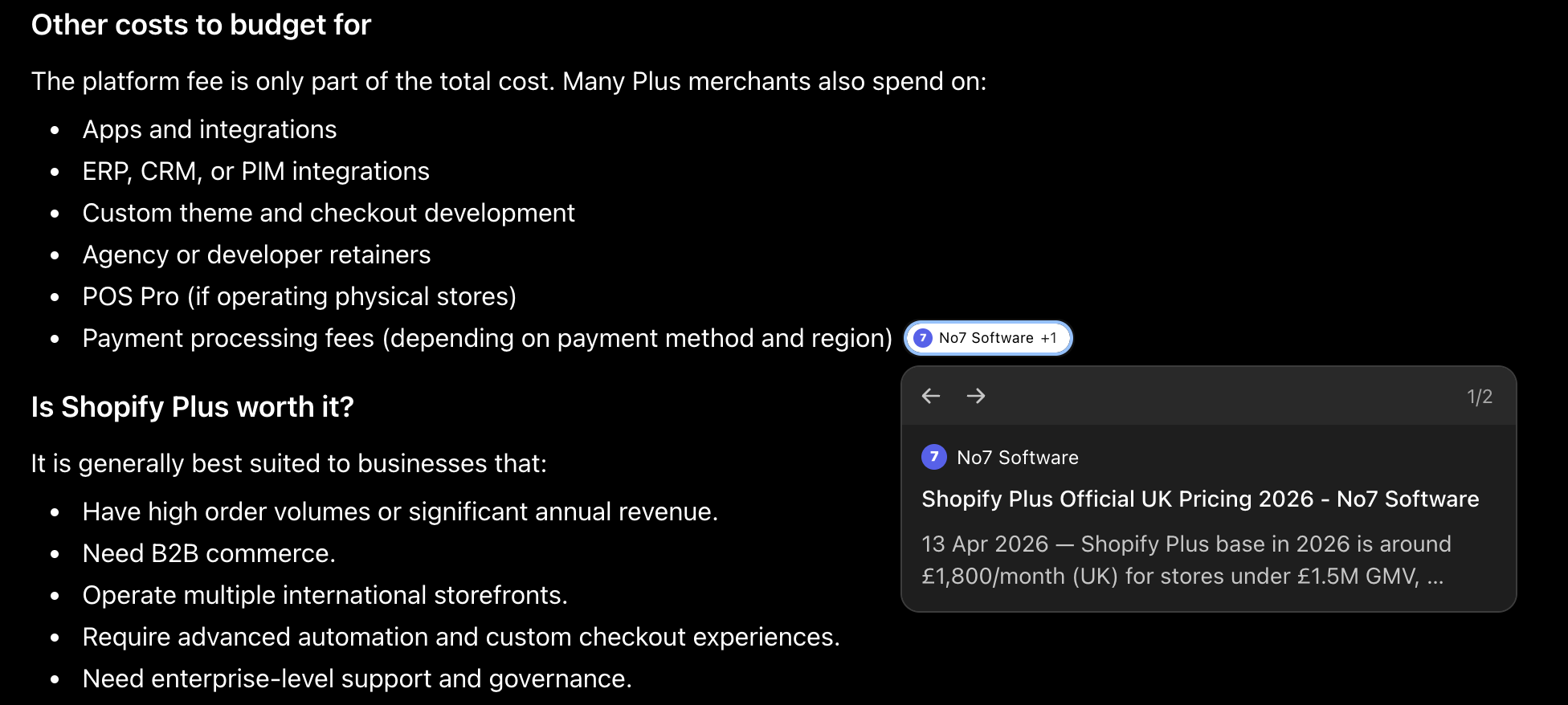
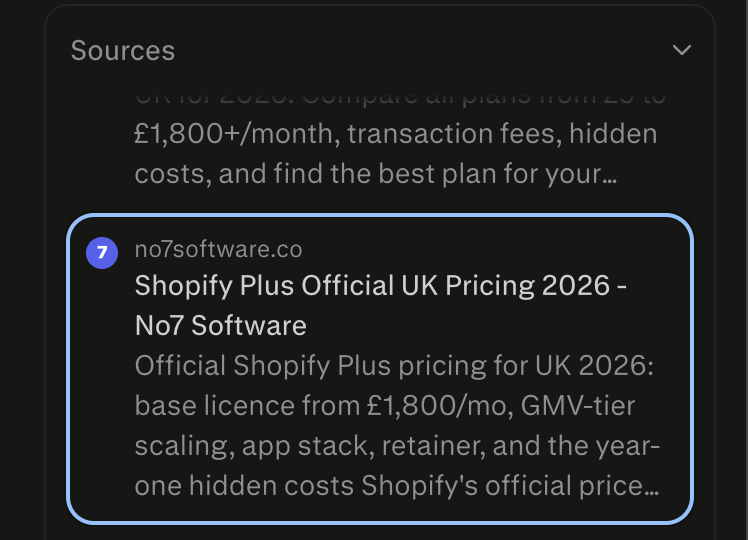
AI answers vary by session, account and date; screenshots show real results captured on 11 July 2026. Run the query yourself for the current answer.
AI answers are a one-slot shelf. Someone is on it, or nobody is.
Google now puts an AI summary on roughly one in five searches, and when it does, Pew Research measured clicks on ordinary results nearly halving, from 15% to 8%. Assistants like ChatGPT and Perplexity answer buying questions with two or three cited sources instead of ten blue links. Most small and mid-sized businesses have done nothing about it. That is the opportunity: for the long-tail questions your buyers actually ask, the citation slot is frequently empty. The sprint claims it before a competitor does.
- Our engineering blog, last 28 days
- ~69,000 search impressions
- earned with the same playbook we sell
- Do we practise it?
- ChatGPT cites us.
- and Perplexity too; the screenshots are below
- The guarantee
- In writing.
- the questions we measure against and the pass bar land in your kickoff email, before any work starts
What £1,999 buys, precisely.
No retainer, no scope creep, no strategy theatre. Five deliverables, listed, with a measured result at the end.
Day-1 technical audit and baseline
All 8 AI-readiness signals scored, plus a screenshot-archived baseline run of your question panel across all four engines.
On-site AI-readiness engineering
Every technical signal AI engines check before they will cite a site, fixed. Deployed by us, or handed over as exact patches your developer applies.
Off-site authority and presence
Your business made consistently visible in the external places AI engines trust and cross-check when they choose who to cite. Anything public is fact-checked and signed off by you first.
Day-14 before and after evidence pack
Every question re-tested and screenshotted. Wins and losses both shown, with a full methodology appendix. Publishable to your board as-is.
Fourteen days, four moves.
- 1
Baseline
Days 1-2
We audit your site and define your question panel in writing. The baseline test runs, screenshot-archived, at kickoff.
- 2
Make the site citable
Days 2-4
The engineering leg: your site rebuilt to be readable, trustable and liftable by AI engines. This is the proprietary part of the sprint.
- 3
Earn third-party presence
Days 3-10
AI engines trust what others say about you more than what you say about yourself. We put your name where the engines look; you approve anything published.
- 4
Prove it
Day 14
Full panel re-test with screenshots, then the before and after report. Hit the bar or get your money back. The evidence decides, not us.
The guarantee
The small print, printed large.
Guarantees in this industry usually hide behind vague words like “exposure”. Ours is a number, agreed in writing before we start.
- We define the question panel for your market and hand it to you in writing at kickoff. None of the questions contain your brand name, because branded questions are trivial wins and trivial wins don’t count.
- Day 14: the full panel runs on ChatGPT with search, Perplexity, Google AI Overviews and Claude. Every answer is screenshotted and dated.
- The bar: your business named or cited across the panel, at a pass level fixed in writing at kickoff, on at least two of the four engines.
- Miss it and the full £1,999 is refunded within 5 working days. You keep the report, the site fixes and the coverage.
- And the absolute floor: if we can’t get you cited on even one question on one engine, the refund is automatic. No discussion.
Built for
- UK businesses with a real product or service and a website AI engines can read: shops, trades, B2B services, SaaS and fintech teams, clinics, agencies.
- eCommerce brands on Shopify, BigCommerce or WooCommerce whose category questions are being answered without them.
- Professional services and local businesses where one cited answer is worth a client: solicitors, accountants, specialist consultancies, multi-branch retail.
- Owners who watched search traffic soften and suspect, correctly, that AI answers are where it went.
- Teams that want a measured outcome, not a monthly retainer that reports activity.
Not for
- Businesses that want to beat national head terms in two weeks. That ladder is real, it takes months, and the report shows it honestly.
- Sites behind login walls or with nothing substantive published. AI engines cannot cite what they cannot read. Fix the site first; we can help with that too.
- Thin affiliate, scraped-content or dropshipped-catalogue sites with no real substance behind them. AI engines are built to filter these out, and no amount of engineering makes an engine trust a site that gives buyers nothing. We will tell you on the intro call rather than take the money.
- Brand-new domains with no trading history and nothing verifiable about the business. Get a few months of real operation behind you first.
- Regulated claims we cannot verify: medical outcomes, financial returns, legal guarantees. If your visibility depends on claims like these, we are the wrong partner.
- Anyone hoping for fabricated reviews or fake coverage. We publish facts you confirm, or nothing.
Asked before booking
What is AI visibility?
AI visibility is how often AI assistants such as ChatGPT, Perplexity, Claude, Gemini and Google's AI Overviews name or cite your business when someone asks a buying question in your category. It is the AI-era equivalent of ranking on page one: the assistant typically presents two or three sources, and businesses outside that shortlist are invisible to that buyer.
Is the AI visibility audit really free?
Yes. Enter your domain and the audit scores your site across 8 AI-readiness signals in about 60 seconds, with your grade and the top fixes shown on screen. No email is needed to see your score. The paid Sprint is entirely optional and exists for businesses that want the visibility problem fixed for them, with a guarantee.
What exactly counts as "visible" for the Sprint guarantee?
At kickoff we define a panel of buyer-intent questions for your market, the questions your customers plausibly ask AI assistants, and hand it to you in writing. None contain your brand name. On day 14 we run the full panel across ChatGPT with search, Perplexity, Google AI Overviews and Claude, and screenshot every answer. The pass bar, a fixed share of the panel cited on at least two of the four engines, is written into your kickoff email before work starts. Miss it and you get the full £1,999 back within 5 working days.
What do you actually do during the 14 days?
Day 1: full technical audit plus a screenshot-archived baseline test of your question panel. Days 2 to 13: we do the engineering and authority work that makes AI engines able to find, trust and cite your business. The exact playbook is proprietary; it is what you are paying for, and it involves nothing you would not sign off. Day 14: we re-test the panel and hand you the before and after evidence pack.
How do I improve brand visibility in AI search engines?
Three levers move it: improve your site’s AI searchability so engines can technically read it, publish content that answers the exact questions buyers ask, and earn third-party sources that corroborate who you are. Most businesses have done none of the three, which is why early movers surface fast. The free audit above shows where you stand on the first lever in 60 seconds; the Sprint does all three for you with the outcome guaranteed in writing.
What are the best AI visibility tools?
For measurement, AI search monitoring tools such as Otterly, Peec AI and ZipTie track how often AI assistants mention a brand, LLM rank trackers follow your position in AI answers over time, and our free audit above scores how ready your site is to be cited at all. The honest caveat: every AI visibility platform measures the problem rather than fixing it. The Sprint exists for the fixing part, which is why it comes with a money-back guarantee instead of a dashboard.
What is the best way to track brand mentions in AI search?
Continuous AI search monitoring tools and LLM visibility checkers watch mentions over time, and an AI search rank checker tells you where you appear for a specific question. For a one-off snapshot, the free audit above is enough. During the Sprint the tracking is done for you: a screenshot-archived baseline of your question panel on day 1, and a full re-run across ChatGPT, Perplexity, Google AI Overviews and Claude on day 14, so the movement is evidenced rather than estimated.
Does the audit check Google AI Mode and AI Overviews?
Yes. The free check works as an AI Overview checker and an AI Mode SEO check in one: the 8 signals it scores, structured data, feeds, machine-readable pages and llms.txt among them, are the same signals Google AI Mode, AI Overviews and answer engines such as ChatGPT, Perplexity and DeepSeek rely on to read and cite a site.
Who provides ChatGPT visibility audits for brands in the UK?
No7 Software, the Companies House-registered UK company behind this page, provides a free ChatGPT visibility audit for any website via the checker above, and runs the Sprint as the agency that tracks and fixes brand mentions in ChatGPT and Perplexity, with Gemini and Claude measured too. It is built for B2B services, SaaS, fintech and eCommerce brands that want the work done for them with the outcome in writing.
Why 14 days? SEO takes months.
Classic keyword rankings do take months. AI answers work differently: engines like Perplexity and ChatGPT retrieve and cite recently indexed, well-structured sources within days, and most small businesses have zero optimised AI presence, so the first-mover gap closes fast. The 14-day window is engineered around long-tail buyer questions where citation competition is thin. Head-term visibility still takes months, and the report shows you that ladder honestly.
Will anything be published about my business without my approval?
No. Anything that names your business is built from facts you confirm in writing and is signed off by you before it goes anywhere. Nothing fabricated, nothing you have not seen. If a claim cannot be verified, it does not get used.
What do you need from me?
About an hour in total: a 15-minute intro call, confirming the facts behind anything we publish about you, and deploy access to your site or a technical contact who can apply the exact patches we hand over. Everything else is done for you.
How is the £1,999 paid, and is there VAT?
It starts with a free 15-minute call, not a payment form. If the Sprint is a fit, you pay the fixed fee by card via a Stripe invoice link after the call. Prices are exclusive of VAT where applicable. If the day-14 guarantee bar is missed, the refund is the full amount you paid, processed to the original payment method within 5 working days.
Last updated: 16 July 2026
The citation slot for your niche is open today.
£1,999 fixed. Fourteen days. A written question panel, four engines, screenshots as evidence. Cited, or fully refunded. It starts with a free 15-minute call.
Want your score first? Run the free check
Prices exclusive of VAT where applicable. Guarantee terms as stated above; eligibility requires a publicly crawlable site and a 48-hour turnaround when we ask you to confirm facts about your business. No7 Software Limited, registered in England & Wales, Company No. 15251801.